Food & Shopping
One of the great eating cities on earth, and you can do it on HK$100 a day.
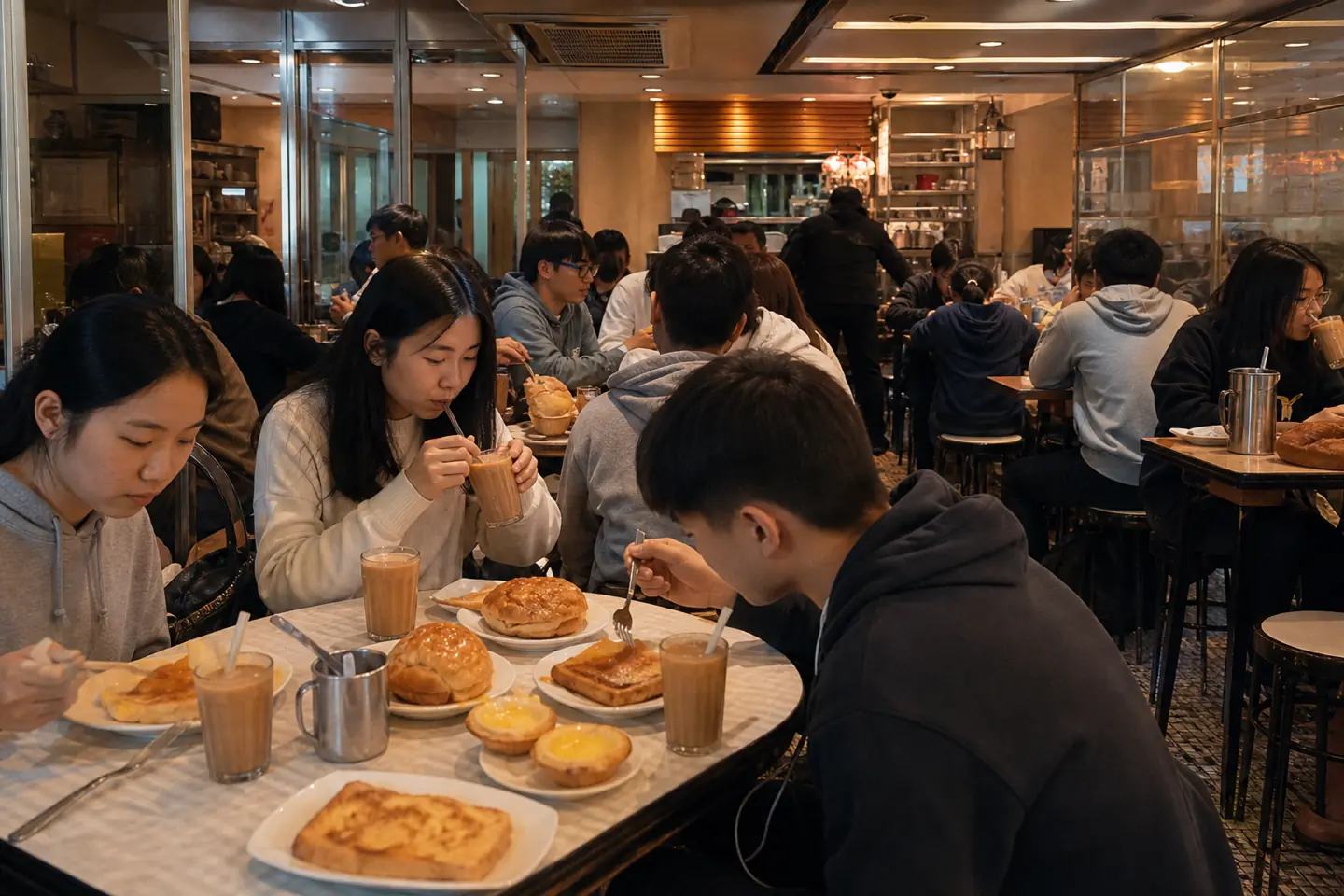
Hong Kong has more restaurants per capita than almost anywhere, spanning HK$25 noodle counters to three-Michelin-star dining rooms. Eating out is not a treat here, it is the default: kitchens are small, food is cheap, and a bowl of wonton noodles costs less than the ingredients would.
The vocabulary you need
Cha chaan teng · 茶餐廳
The Hong Kong diner, and the single most important institution in your student life. Formica tables, brisk service, an enormous laminated menu. Milk tea, pineapple buns (菠蘿包, no pineapple in them), Hong Kong French toast, macaroni soup, baked pork chop rice, instant noodle sets. A full meal HK$35–70. There is one within 5 minutes of wherever you live.
Dai pai dong · 大排檔
Open-air licensed cooked-food stalls with plastic stools on the pavement. A dying breed, with only a couple of dozen licences left. Wok hei, cold beer, tremendous noise. Sham Shui Po, Central's Stanley Street and Temple Street are the places to find them. HK$50–100 a head.
Dim sum · 點心
Small steamed and fried dishes with tea, traditionally at breakfast and lunch. Har gow, siu mai, char siu bao, cheung fun, egg tarts. Order by ticking a paper card. Neighbourhood places HK$60–100 a head; a proper Sunday banquet HK$150–250.
Siu mei · 燒味
Roast meats hanging in the window: char siu (barbecued pork), roast goose, soy chicken, crispy pork belly. Order over rice or noodles. HK$45–80. Roast goose over rice is the one to try first.
Wet market · 街市
Municipal markets with fresh meat, fish, vegetables and fruit, usually with a cooked food centre upstairs where the food is excellent and half the price of the street. Cheaper than supermarkets and better quality. Bring cash and a bag.
Tong sui · 糖水
Sweet soups and dessert shops, eaten after dinner. Mango sago, black sesame soup, tofu fa, red bean. HK$25–50. Open late, and where everyone ends up after a night out.
Eating on a student budget
| Lean | Moderate | Comfortable | |
|---|---|---|---|
| Breakfast | HK$15–25 · toast set and milk tea at a cha chaan teng, or congee | HK$25–45 · café, bakery, or a proper dim sum breakfast | HK$45–90 · brunch culture, which Hong Kong takes seriously |
| Lunch | HK$28–45 · campus canteen, rice box (飯盒), or a noodle shop | HK$50–80 · set lunch at a proper restaurant, which is the best-value meal in the city | HK$90–160 · anywhere you like |
| Dinner | HK$35–55 · cooked at home, or siu mei over rice | HK$60–100 · shared local restaurant dishes | HK$120–250 · hotpot, Japanese, international |
| Daily | HK$80–125 (~US$10–16) | HK$135–225 (~US$17–29) | HK$255–500 (~US$33–64) |
Between roughly 11:30 and 15:00, restaurants across every price bracket run 商務套餐 set lunches: a main, soup or salad, and a drink, for HK$60–120. The same dishes cost double at dinner. Michelin-listed restaurants do this too. Eat your one nice meal a week at lunchtime and you will halve the bill.
Groceries
| Where | What it is | Best for |
|---|---|---|
| Wellcome 惠康 / ParknShop 百佳 | The two big chains, one on every other corner | Everything basic. Both run heavy weekly promotions, so check the shelf tags |
| Wet market 街市 | Municipal fresh markets, cash only, no English needed beyond pointing | Fresh produce, meat and fish at 30–50% below supermarket prices. Go late afternoon for markdowns |
| AEON / AEON MaxValu | Japanese supermarket | Fresh Japanese produce, bento, excellent snacks, good frozen section |
| Don Don Donki | Japanese discount chain, some branches open very late | Cheap snacks, household goods, ready meals, and an entire student food group of its own |
| 759 Store / Best Mart 360 | Discount snack and dry-goods chains | Imported snacks and drinks at well below supermarket prices |
| city'super / Fusion / Marketplace | Upmarket, wide imported range | Homesickness purchases. Expensive, but sometimes worth it |
| HKTVmall / PandaMart | Online, delivered | Bulk and heavy items: rice, water, detergent. Free delivery over ~HK$200–300 |
Dietary needs
Vegetarian & vegan
Well served, and cheaply. Buddhist vegetarian restaurants (look for 齋 or 素食) are everywhere and cost HK$40–70 for a full meal. Modern plant-based options at Green Common, Mana!, Treehouse, Nature's Village. In Cantonese, *'ngo sik jaai'* (我食齋) communicates it clearly. Watch for oyster sauce and fish sauce in otherwise vegetable dishes, and for chicken stock in soups.
Halal
The main concentration is around Kowloon Masjid in Tsim Sha Tsui, plus Wan Chai and Yau Ma Tei: Pakistani, Indonesian, Malay, Indian, Middle Eastern and Uyghur restaurants. The Islamic Centre in Wan Chai runs a canteen. Several universities have prayer rooms and halal canteen options; ask the Muslim students' society, which will know far more than any list. HalalHongKong and the Incorporated Trustees of the Islamic Community Fund publish certified listings.
Kosher
Limited but real. The Jewish community in Mid-Levels supports kosher restaurants and a small grocery. The Jewish Community Centre in Mid-Levels is the hub.
Gluten-free & coeliac
The hardest need to meet at local eateries: soy sauce is in almost everything and cross-contamination is normal. Western restaurants, Green Common, city'super and health food shops carry gluten-free products. Cook more than you would otherwise, and carry your own tamari.
Allergies
Shellfish, peanut, sesame, soy and egg are pervasive in Cantonese cooking, and dried shrimp or fish appears in dishes with no obvious seafood. Get an allergy card written in Chinese — your international student office will help — and carry your adrenaline auto-injector. Menu labelling is not standardised, so ask every time.
Delivery apps
- foodpanda — the widest coverage in Hong Kong, including the New Territories. Aggressive new-user promotions.
- Keeta — Meituan's Hong Kong operation, the most price-competitive, and it has been buying market share with heavy discounts.
- Ways to cut the cost: group orders with flatmates to clear minimums and split one delivery fee; choose pickup and walk (often 20–30% cheaper); order from the restaurant directly, since many campus-area places take WhatsApp orders with no commission; and cycle promo codes between the two apps rather than staying loyal to one. (Deliveroo exited Hong Kong in 2025, so ignore older guides that recommend it.)
Delivery fee, platform fee, a small-order surcharge and inflated in-app menu prices routinely add 40–60% to a meal. HK$60 of food becomes HK$95. Twice a week, that is HK$3,000 a year. Walking ten minutes is genuinely the difference between a lean budget and a moderate one.
Tipping and table etiquette
- Tipping is not expected. Most sit-down restaurants add a 10% service charge automatically; that is the tip.
- At casual places and cha chaan tengs, leaving the loose coins is a normal courtesy and nothing more is needed.
- At high-end restaurants, rounding up or adding a further 5% for genuinely good service is appreciated but not required.
- Tea-pouring: when someone refills your cup, tap two fingers on the table twice. It means thank you and it is one of the most satisfying local customs to pick up.
- Dishes are shared, served to the middle, and you take from the communal plate to your own bowl. Serve others before yourself, especially anyone older.
- Rinsing your cup and chopsticks in the pot of hot tea at the start of a meal is normal, not an insult to the restaurant. There is a bowl for the water.
- You ask for the bill by saying 'maai daan' (埋單) or making a small writing gesture in the air. Nobody brings it unprompted.
Household shopping
For the HK$800 you will spend furnishing your room in week one: IKEA (Causeway Bay, Kowloon Bay, Tsuen Wan, Sha Tin) for bedding and storage; Japan Home Centre and Pricerite for cheap homeware, hangers, drying racks and kitchen basics; Muji for nicer versions of the same; Watsons and Mannings for toiletries; Decathlon for a hiking bag and trainers; Sham Shui Po's Apliu Street for cheap electronics, cables and adapters; and Mong Kok's Fa Yuen Street for everything else at a price you can haggle.
Tap through the phrasebook and quiz yourself.