Culture & Language
How much Cantonese you need, and the etiquette that makes life smoother.
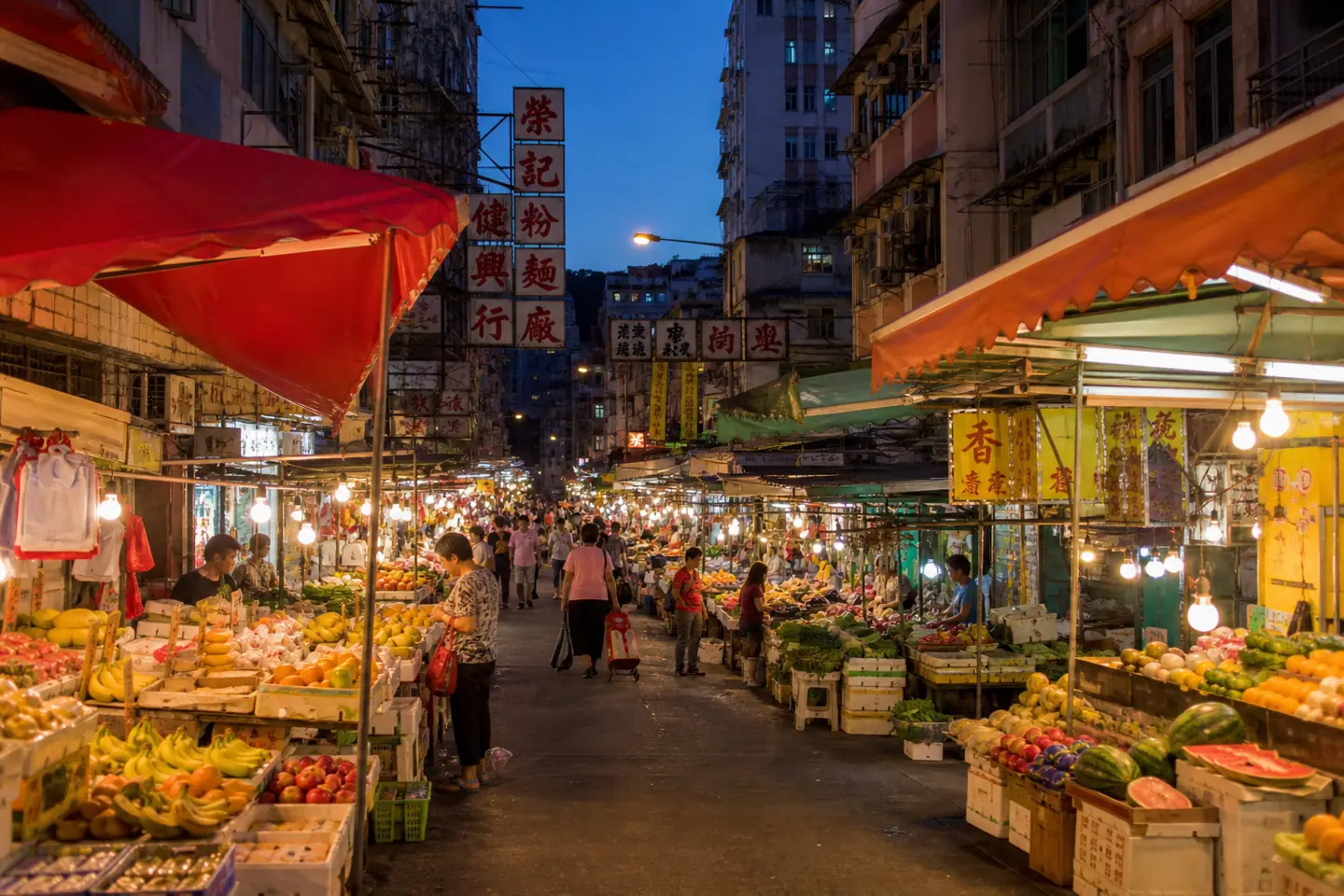
Three languages, different jobs
- Cantonese (廣東話) is the mother tongue of roughly 88% of the population and the language of daily life: the wet market, the minibus, the noodle shop, local TV, and every conversation you overhear. Tonal, with six tones, and written with traditional Chinese characters.
- English is an official language, the medium of instruction at nearly every degree programme, and the language of law, finance, government forms and all public signage. You can live here entirely in English. Many students do.
- Mandarin (普通話) is increasingly understood, especially by younger people and in retail, but it is not interchangeable with Cantonese and assuming so is a small social misstep.
- Written Chinese here is traditional (繁體字), not the simplified characters used on the mainland. If you have studied Mandarin with simplified characters, you will read maybe 70% of a Hong Kong sign at first.
For your degree: none. For a good life here: about thirty words. The gap between zero Cantonese and 'hello, thank you, how much, delicious' is enormous and takes a fortnight to close. It changes how shopkeepers, taxi drivers and canteen aunties treat you, immediately and noticeably. Learn the ten phrases below before you learn the grammar.
Your first thirty words
Universal and always safe
The most useful word in Cantonese. Also means 'excuse me'
For something given, not something done
Mild apology, bumping into someone
Squeezing past on a packed MTR
Deploy freely and without shame
Locals also just say 'bye bye'
On tones: Cantonese has six, and getting them wrong mostly produces confusion rather than offence. The romanisation above is Jyutping, with the number marking the tone. Do not let tones stop you speaking; Hong Kong people are used to hearing their language mangled and will meet you more than halfway.
Where to learn: nearly every university runs free or cheap Cantonese classes for non-local students — take the beginner course in semester one, when you have the most time. Beyond that, the language exchange programme is the highest-value option, plus apps like Cantonese Class 101 and Pleco for the dictionary. Watching TVB dramas with subtitles is how a surprising number of exchange students get their ear in.
Etiquette that smooths everything
Queueing is sacred
Hong Kong queues for everything: buses, lifts, taxis, bubble tea. Orderly lines form without instruction and cutting in is one of the few things that will get you publicly told off. Also: stand right on escalators, walk left.
Two hands
Give and receive business cards, documents, gifts and change with both hands, or at minimum the right hand supported by the left. With a business card, take a moment to actually read it before putting it away. Small gesture, noticed every time.
Respect for elders
Older people are addressed and treated with deference: offer your seat without being asked, let them order first, serve them food before yourself. Informally you may hear people use *suk-suk* (uncle) and *aa-yi* (auntie) for older strangers.
Shoes off indoors
Most Hong Kong homes are shoes-off at the door, and slippers are usually offered. Assume shoes off unless told otherwise.
The tea tap
When someone refills your tea, tap two fingers on the table twice. It means thank you without interrupting the conversation, and it is the single most satisfying local habit to adopt.
Gifts: what not to give
Avoid clocks ('giving a clock' 送鐘 sounds like attending a funeral), cut flowers in white (funeral colours), sharp objects (severing a relationship), and anything in fours (四 sounds like 死, death). Fruit, good biscuits, imported chocolates and tea are all excellent. Eight is the lucky number; use it if you are choosing quantities.
Face
Public criticism, open disagreement in a group, and putting someone in a position where they must say no are all avoided. If a request gets 'maybe' or 'it might be difficult', that is usually a polite no. Deliver difficult feedback privately.
Red packets · 利是
At Lunar New Year, married people give red envelopes of cash to unmarried juniors, including students. Receive with both hands, do not open it in front of the giver, and say *'gung hei faat coi'* (恭喜發財). You may well be given several; it is a genuine kindness, not a transaction.
The festival calendar
| Festival | When | What happens | How to join in |
|---|---|---|---|
| Lunar New Year 農曆新年 | Late Jan – mid Feb | The biggest holiday by far. 3–4 public holidays, flower markets, a night parade, harbour fireworks, lion dances, and much of the city closing for two days | Do not fly home for it. Get invited to a family dinner, visit the Wong Tai Sin or Che Kung temples, walk the Victoria Park flower market at midnight, collect your red packets |
| Ching Ming 清明節 | Early April | Families visit and tend ancestral graves. A public holiday and a quiet, respectful day | Not a visitor's festival. Use the day off for a hike |
| Dragon Boat / Tuen Ng 端午節 | June | Dragon boat races across the territory, and eating zongzi (sticky rice parcels) | Join your university's dragon boat team — they take total beginners in the spring. Or watch the races at Stanley or Sai Kung |
| Hungry Ghost 盂蘭節 | August | Offerings burned in the street, Cantonese opera in temporary bamboo theatres | Wander a neighbourhood in the evening and look, respectfully |
| Mid-Autumn 中秋節 | Sep / Oct | Mooncakes, lanterns, and families gathering to look at the full moon. Lantern displays in Victoria Park and the Tai Hang Fire Dragon Dance | Buy a lantern, get mooncakes (they are an acquired taste and you should acquire it), go to Victoria Park after dark |
| Christmas & New Year | Dec / Jan | Hong Kong does Christmas with total commercial commitment: harbourfront light shows, decorated malls, a countdown with fireworks | Two public holidays. The harbour on New Year's Eve is genuinely spectacular |
| Cheung Chau Bun Festival | May | A single island, giant bun towers, a parade of children floating above the crowd | A ferry and a day trip. One of the strangest, best things in Asia |
If a local classmate invites you to a Lunar New Year or Mid-Autumn family dinner, say yes, bring fruit or good biscuits, and expect to be fed to the point of discomfort. It is the single fastest way to understand Hong Kong, and being asked is a real compliment.
Small practical things nobody tells you
- Plastic bags cost HK$1 each by law. Carry a tote and say *'m sai gaau doi'* (no bag needed).
- Buildings often skip the 4th, 14th and 24th floors — 四 sounds like death. Your '13th floor' flat may be physically on 11.
- Air conditioning indoors is arctic. Restaurants, lecture halls, libraries and cinemas run at 20°C in August. Carry a light layer year-round; locals do.
- Umbrellas are for sun as well as rain, and nobody will think it odd.
- Dehumidifiers are essential, not optional. In spring, indoor humidity hits 95% and things genuinely grow mould in a wardrobe.
- Escalators outdoors — the Central–Mid-Levels escalator is 800 m long, runs downhill until 10:00 and uphill after, and is a legitimate commuting route.
- Everyone uses WhatsApp, including your landlord, your lecturer's TA, your bank's relationship manager and your noodle shop.
- Address numbers can be baffling and Chinese and English street names sometimes bear no relation to each other. Navigate by MTR exit letter and building name.
The phrasebook has a quiz mode.