University Life
How class actually works, and what your professors expect.
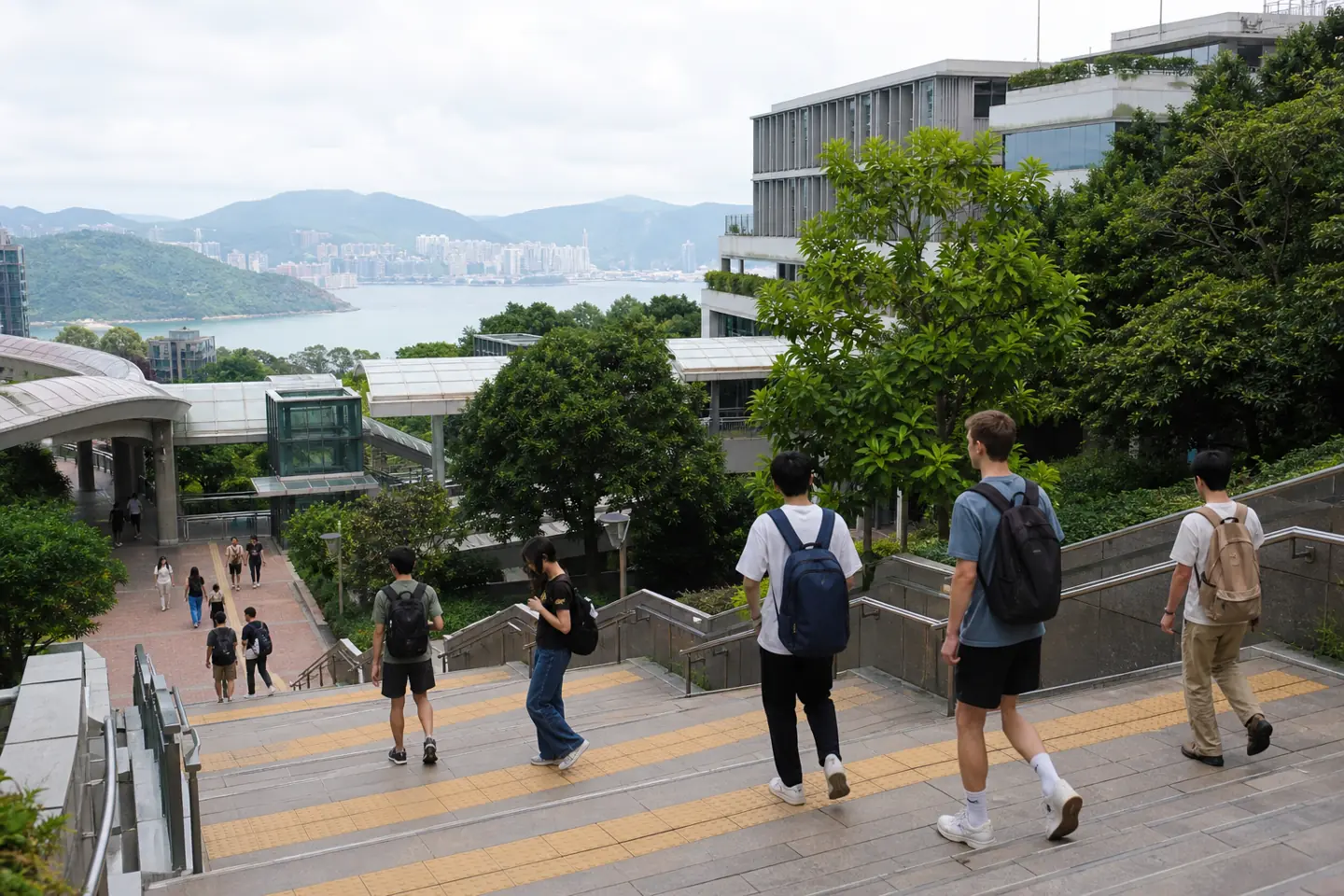
The eight universities, honestly characterised
HKU · 香港大學
Founded 1911, the oldest. Colonial-era architecture on a Mid-Levels hillside. Traditionally strongest in law, medicine, humanities and social sciences. Formal, prestigious, intensely international. Its halls have decades-old traditions.
CUHK · 香港中文大學
A vast wooded campus in Sha Tin with its own MTR station and internal bus network. A collegiate system of nine colleges, each with its own dining hall and identity, which makes a big university feel small. Strong in business, medicine, social sciences and Chinese studies.
HKUST · 香港科技大學
Founded 1991, modern and ambitious, on a hillside above Clear Water Bay with an extraordinary sea view. Engineering, science and business. The most start-up-minded campus in the territory.
CityU · 香港城市大學
Urban campus plugged directly into Festival Walk mall and Kowloon Tong MTR. Creative media, engineering, data science, veterinary medicine, business. Extremely convenient, very connected.
PolyU · 香港理工大學
Distinctive red-brick campus in Hung Hom. Applied and professional: design (the Jockey Club Innovation Tower is a Zaha Hadid building), engineering, hotel and tourism management, health sciences, construction.
HKBU · 香港浸會大學
Compact and close-knit in Kowloon Tong. Journalism and communication are its flagship, alongside Chinese medicine, creative arts and business. Smaller cohorts, more contact with staff.
Lingnan · 嶺南大學
Hong Kong's liberal arts university, in Tuen Mun. Around 3,000 students, small classes, whole-person education, near-universal hall residence. If you want to be known by name, this is the one.
EdUHK · 香港教育大學
In Tai Po, focused on education, early childhood, psychology and social sciences. The principal route into teaching in Hong Kong.
Five Hong Kong universities sit in the global top 100 and the gaps between them are far smaller than the gaps between departments. The right question is not 'which university is best' but 'which department, which supervisor, which city corner do I want to spend three years in'. You have already chosen. Stop reading rankings.
Academic expectations
- Participation. Many courses allocate 10–20% of the final grade to it. Hong Kong classrooms are traditionally quieter than North American ones, which means a prepared question genuinely stands out. Speak in week one before it gets harder.
- Attendance. Most programmes track it, and many set a minimum around 70–80% for eligibility to sit the exam. It also matters for your visa, which requires you to be a bona fide full-time student.
- Plagiarism. Taken extremely seriously and screened with Turnitin as standard. Penalties run from a zero on the assignment to expulsion and a transcript annotation. This includes self-plagiarism (resubmitting your own work) and improperly declared AI use.
- AI tools. Policies vary enormously by course and are evolving fast. Read each course's specific statement rather than assuming, and when a syllabus is silent, ask the lecturer in writing.
- Grading. Letter grades A+ to F on a 4.0 or 4.3 GPA scale. Curved grading is common in large courses, meaning your grade depends partly on the cohort. Some courses are pass/fail.
- Deadlines are firm. Extensions exist but need a documented reason, requested in advance, not the night before.
Paraphrasing a source closely and citing it at the end of the paragraph is still plagiarism if the sentence structure is theirs. So is submitting an assignment you wrote for another course. So is a group member copying a paragraph into a joint report you put your name on. Cite as you write, keep your notes, and if you are unsure, ask the writing centre before you submit rather than the disciplinary committee afterwards.
A typical week
| Undergraduate | Taught postgraduate | Research postgraduate | |
|---|---|---|---|
| Lectures | 9–15 hrs | 6–12 hrs | 0–3 hrs |
| Tutorials / labs | 3–6 hrs | 2–4 hrs | — |
| Independent study | 15–25 hrs | 20–30 hrs | 35–45 hrs research |
| Societies, sport, work | 5–12 hrs | 3–8 hrs | 3–8 hrs |
| Peak periods | Mid-terms Oct & Mar · finals Dec & May | Same, plus a capstone or dissertation | Continuous, with conference and upgrade deadlines |
Semester one typically runs early September to mid-December with exams to late December; semester two runs January to April with exams in May. There is a long summer from late May, which is when internships, summer schools and travel happen.
Libraries and study space
- Hong Kong university libraries are excellent: multi-million-volume collections, vast e-journal and database access, bookable group study rooms, silent zones, and 24-hour study areas that open up during exam periods.
- Seats become a competitive sport in December and May. Regulars arrive before 09:00. Some libraries run a seat-booking app; learn it in week two, not in exam week.
- Public libraries across the territory are free, air-conditioned, quiet and open to everyone. A genuinely underrated option, and often emptier than campus.
- Cafés: Pacific Coffee and Starbucks tolerate laptops for hours. Independent cafés in Sheung Wan, Sai Ying Pun, Tai Hang and Sham Shui Po are nicer and often have better Wi-Fi.
- Most universities also have maker spaces, media labs, music rooms and language labs free to students. Ask what your student card already opens.
Professors, TAs, and how to e-mail them
- Office hours are underused. Most lecturers hold two hours a week and see very few students. Turning up with one specific question is the cheapest academic advantage available to you.
- Address them properly. 'Dear Professor [Surname]' or 'Dear Dr [Surname]'. Never a first name unless invited, and never 'Hey'.
- Subject lines should be functional: course code, then the issue. *'COMP2123 — clarification on Assignment 2, Q3'.*
- Keep it to five sentences, state what you have already tried, and sign with your full name and student number. Reply within 2–3 working days is normal; a polite follow-up after a week is fine.
- TAs handle most day-to-day questions on marking, labs and tutorials. Ask them first; they are usually postgraduates who were in your seat two years ago.
- Research opportunities: if a professor's work interests you, e-mail them with one paragraph on what specifically interested you and ask whether they take undergraduate research assistants. Many do, many are paid, and it is how postgraduate offers begin.
Group work
Group projects are unavoidable in Hong Kong, often 30–40% of a course grade. They are also where most cross-cultural friction shows up.
- Agree roles, deadlines and a shared document in the first meeting. Write them down and put them in the group chat.
- Set internal deadlines a week before the real one. Someone will miss theirs.
- Communication styles differ. Directness that reads as efficient in Berlin can read as rude in Hong Kong; indirectness that reads as polite locally can read as disengaged to you. Assume good faith and ask clarifying questions rather than escalating.
- Presentations are a big deal. Rehearse aloud, time it, keep slides sparse, and make sure every member speaks. Marks often include individual delivery.
- If a member genuinely stops contributing, document it early and tell the lecturer before submission, not after grades come out.
Balancing everything
The classic first-semester mistake is signing up for six societies, a part-time job and a full course load in September, then dropping all of it by November in a heap. A more durable order:
- 1Semester one: academics and one or two societies
Find out what the workload actually is before you commit your remaining hours. Join two societies you genuinely care about, not eight.
- 2Add work once you know your rhythm
If you need income, tutoring pays best per hour and flexes around your timetable. Ten hours a week is sustainable; twenty is not, alongside a full load.
- 3Year one summer: first internship or summer school
Use career services in October, not April. The good programmes recruit early.
- 4Protect one non-negotiable block
Exercise, a hike, a religious service, a weekly dinner with friends. The thing that keeps you human when the term gets ugly.
Five phrases that buy you goodwill.